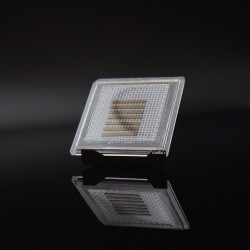
CODIXX Polarisers: colorPol® IR polarizer
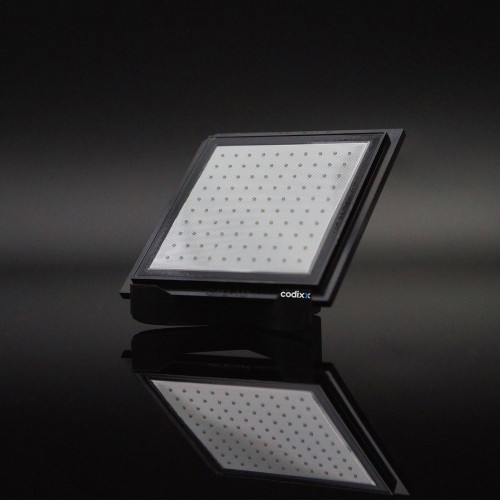
- Stock: Contact us for details
- Click here to: Contact us
- Model: CODIXX Polarisers

Silver Nanoparticle Polarisers
colorPol® IR polarizer
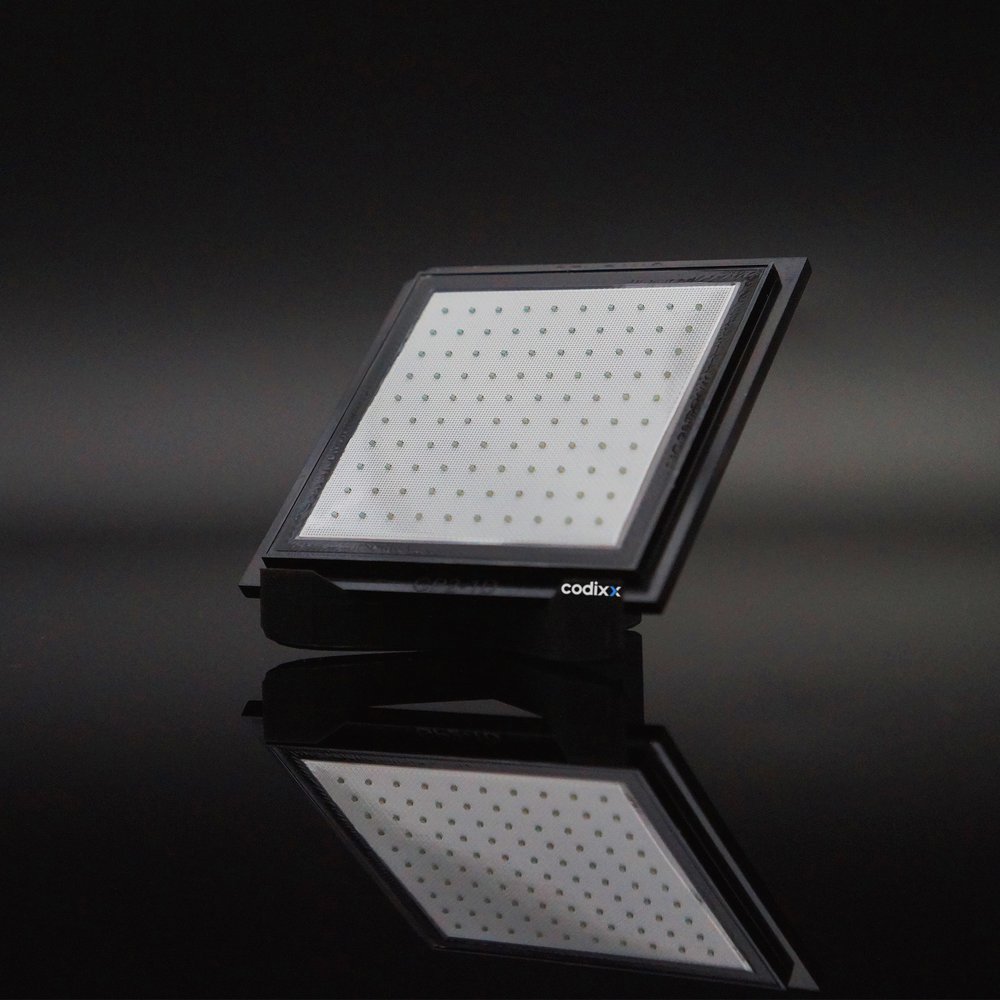
- High contrast
- High transmittance
| Wavelength range | 780 - 5,000 nm |
| Thickness | 0.20 to 0.27 (± 0.05) mm (non-laminated) 2.0 (± 0.2) mm (laminated) |
| Temperature range | - 50 to + 400 °C (non-laminated) - 20 to + 120 °C (laminated) |
| Option | Antireflection coating to increase transmission and to reduce reflection |
| Dimensions | According to specific customer requirements |
More spectral ranges, transmission characteristics and contrast ratios are available.
codixx provides the following standard products for IR range:
→ High contrast, high transmission, broad spectral bandwidth
| colorPol® product | Wavelength range | Transmittance [%] | Contrast k1:k2 | Thickness unlaminated [µm] | Thickness laminated [mm] | Max. dimensions | ||
|---|---|---|---|---|---|---|---|---|
| VIS 700 BC3 | 550-900 | >77 - 86 | >1,000:1 | 220±50 | 2.0±0.2 | ≤100 x 50 | unlaminated / laminated | |
| VIS 700 BC3 CW03 (AR coated) | 550-900 | >84 - 93 | >1,000:1 | 220±50 | 2.0±0.2 | ≤100 x 50 | unlaminated / laminated | |
| VIS 700 BC4 | 600-850 | >78 - 87 | >10,000:1 >1,000:1 | 220±50 | 2.0±0.2 | ≤100 x 50 | unlaminated / laminated | |
| VIS 700 BC4 CW02 (AR coated) | 600-850 | >84 - 93 | >10,000:1 >1,000:1 | 220±50 | 2.0±0.2 | ≤100 x 50 | unlaminated / laminated | |
| VISIR | 600-1,200 | >67 - 84 | >10,000:1 >1,000:1 | 260±50 | 2.0±0.2 | ≤100 x 60 | unlaminated/ laminated | |
| VISIR CW02 (AR coated) | 600-1,200 | >71 - 88 | >100,000:1 | 260±50 | 2.0±0.2 | ≤100 x 60 | unlaminated / laminated | |
| IR 950 BC4 | 800-1,100 | >85 - 87 | >10,000:1 >1,000:1 | 220±50 | 2.0±0.2 | ≤100 x 50 | unlaminated / laminated | |
| IR 950 BC4 CW02 (AR coated) | 800-1,100 | >90 - 94 | >10,000:1 >1,000:1 | 220±50 | 2.0±0.2 | ≤100 x 50 | unlaminated / laminated | |
| IR 1100 BC4 | 900-1,200 | >85 - 87 | >100,000:1 | 220±50 | 2.0±0.2 | ≤100 x 50 | unlaminated / laminated | |
| IR 1100 BC4 CW02 (AR coated) | 900-1,200 | >91 - 94 | >100,000:1 | 220±50 | 2.0±0.2 | ≤100 x 50 | ||
| IR 1300 BC5 | 850-1,600 | >82 - 86 | >100,000:1 >10,000:1 >1,000:1 | 220±50 | 2.0±0.2 | ≤100 x 50 | unlaminated / laminated | |
| NIR | 1,000-2,700 | >77 | 250±65 | 2.0±0.2 | ≤100 x 60 | unlaminated / laminated | ||
| NIR | 1,200-3,000 | >10,000:1 | ||||||
| MIR | 2,000-4,500 | >65 - 90 | >10,000:1 >1,000:1 | 200±50 | - | ≤100 x 50 | unlaminated |
1) Wavelength range up to 2,650 nm and with modified transmittance
The contrast ratio is defined to be k1:k2, where k1is the transmittance of a polarized beam passing the filter and k2 is the transmittance of a polarized beam blocked by the filter.
Contrast ratios ≥100,000:1, other thicknesses, shapes or dimensions on request. Reflection losses can be minimized by antireflection coating. AR-coatings are available for different wavelength ranges as V-coating or wide-band version.
colorPol® IR HT polarizers
→ Low intrinsic losses and highest transmission
High transmittance (HT) polarizers are characterized by a transmittance up to 96% and high contrast ratios over 10,000:1 within the given spectral range.
They are available in standard thicknesses of 0.2 mm, 0.27 mm and 0.5 mm. OEM quantities are shipped in dimension matched waffle packs.
| colorPol® product | Wavelength range | Transmittance [%] | Insertion loss [dB] | Contrast k1:k2 | Thickness1) [µm] | Max. dimensions | ||
|---|---|---|---|---|---|---|---|---|
| IR 1310 BC4 | 1,280-1,500 | >88 | <0.555 | >10,000:1 | 200 ± 50 µm (T2 HT) | ≤100x50 ≤100x60 ≤100x27 | ||
| IR 1310 BC4 CS1310 (single site AR coated) | 1,280-1,500 | >92 | <0.362 | >10,000:1 | 200 ± 50 µm (T2 HT) | ≤100x50 ≤100x60 ≤100x27 | ||
| IR 1310 BC4 C1310 (AR coated) | 1,280-1,500 | >96 | <0.177 | >10,000:1 | 200 ± 50µm (T2 HT) 270 ± 50µm (HT) 500 ± 50 µm (T5 HT) | ≤100x50 ≤100x60 ≤100x27 | ||
| IR 1490 BC4 | 1,450-1,530 | >88 | <0.555 | >10,000:1 | 200 ± 50µm (T2 HT) | ≤100x50 ≤100x60 ≤100x27 | ||
| IR 1490 BC4 CS1490 (single site AR coated) | 1,450-1,530 | >92 | <0.362 | >10,000:1 | 200 ± 50µm (T2 HT) 270 ± 50µm (HT) 500 ± 50 µm (T5 HT) | ≤100x50 ≤100x60 ≤100x27 | ||
| IR 1490 BC4 C1490 (AR coated) | 1,450-1,530 | >96 | <0.177 | >10,000:1 | 200 ± 50µm (T2 HT) 270 ± 50µm (HT) 500 ± 50 µm (T5 HT) | ≤100x50 ≤100x60 ≤100x27 | ||
| IR 1550 BC4 | 1,480-1,650 | >88 | <0.555 | >10,000:1 | 200 ± 50µm (T2 HT) 270 ± 50µm (HT) 500 ± 50 µm (T5 HT) | ≤100x50 ≤100x60 ≤100x27 | ||
| IR 1550 BC4 CS 1550 (single site AR coated) | 1,480-1,650 | >92 | <0.362 | >10,000:1 | 200 ± 50µm (T2 HT) 270 ± 50µm (HT) 500 ± 50 µm (T5 HT) | ≤100x50 ≤100x60 ≤100x27 | HT | |
| IR 1550 BC4 C1550 (AR coated) | 1,480-1,650 | >96 | <0.177 | >10,000:1 | 200 ± 50µm (T2 HT) 270 ± 50µm (HT) 500 ± 50 µm (T5 HT) | ≤100x50 ≤100x60 ≤100x27 | ||
| IR 2000 BC2 HT | 1,600-2,500 | >90 | <0.457 | >100:1 | 220+/-50 (HT) | ≤100x50 | HT | |
| IR 2000 BC2 HT CW06 (AR coated) | 1,600-2,500 | >96 | <0.177 | >100:1 | 220+/-50 (HT) | ≤100x50 | HT |
1) Laminated thicknesses can be found in the specification and on request.
The contrast ratio is defined to be k1:k2, where k1is the transmittance of a polarized beam passing the filter and k2 is the transmittance of a polarized beam blocked by the filter.
colorPol® polarizer
 CODIXX 2019 Brochure
 Terms and Conditions V6